
Press ReleaseAramco and Weel & Sandvig sign MoU to explore AI-enabled Emission Intelligence for combustion assets
Aramco and Weel & Sandvig have signed a Memorandum of Understanding to explore collaboration within advanced emissions monitoring, Predictive Emission Monitoring Systems (PEMS), first-principles digital twins and AI-enabled analytics for combustion assets.
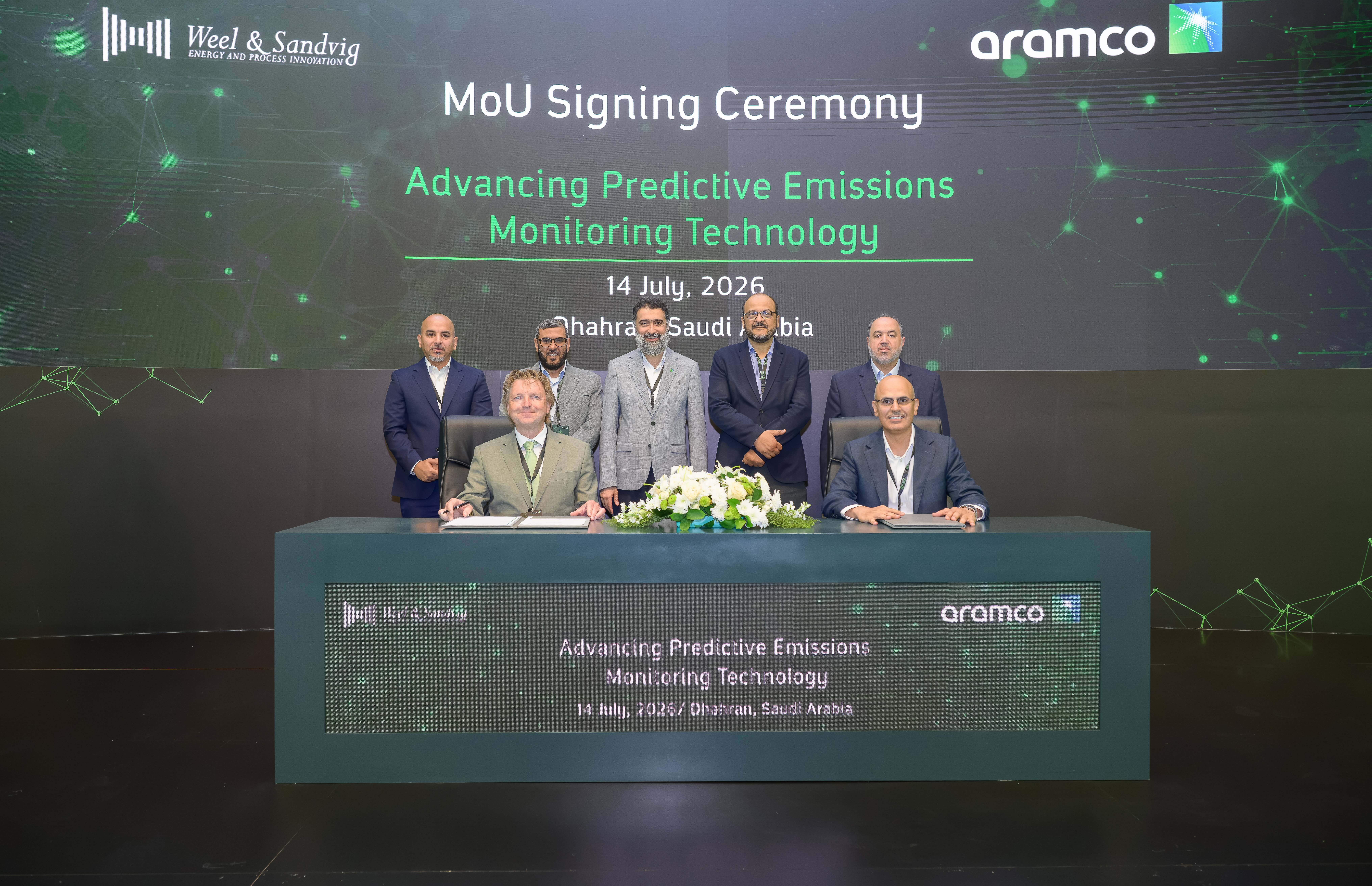
The MoU provides a framework for the parties to examine opportunities in software-based emissions monitoring, methane and CO₂ insight, data integration, AI-driven predictive models, digital twin integration, centralised PEMS dashboards, and technical knowledge sharing.
The collaboration aims to support the development of actionable emission intelligence that can enhance operational efficiency, improve emissions transparency and identify practical emissions-reduction opportunities.
Together with Aramco's AI and technical teams, we see a unique opportunity to advance Emission Intelligence by combining first-principles digital twins, validated PEMS data and industrial AI to support real sustainability improvements.
Jan Sandvig, CEO, Weel & Sandvig
Weel & Sandvig's WS.PEMS platform is designed to support emission monitoring from individual combustion sources to large-scale applications spanning multiple facilities. The system is used by major oil and gas companies across the world in onshore, offshore and marine applications, supporting compliance monitoring, OGMP methane reporting, NOx taxation and operational emission insight. WS.PEMS is founded on first-principles digital twins of combustion equipment, combined with validated plant data, online data reconciliation and an AI-enabled analytics layer. This enables the platform to move beyond traditional emission monitoring and into Emission Intelligence: helping users understand why emissions change, which operating conditions drive them, and what actions may reduce emissions or improve energy efficiency.
The platform is also designed to interact with customers' in-house AI tools through an MCP interface, enabling approved enterprise AI systems to query validated emission and operational data while maintaining customer control over data governance and cybersecurity requirements.
The MoU marks an important step in exploring how advanced PEMS, digital twins and AI-enabled analytics can support the next generation of emissions monitoring: moving from reported values to actionable intelligence for lower emissions and more efficient operations.